Sunday, October 12, 2014

Mid Term Study Guide


Lab Safety Colors


Reverse Engineering
Reverse engineering is perfect to help solve problems faster. By taking something apart 
you can see how the person built the product. By seeing that you can understand the 
mechanics of the product and make it even better. 


TSA


Mission Statement:

The Technology Student Association fosters personal growth, leadership, and opportunities in Science, Technology, Engineering, and Mathematics (STEM); members apply and integrate these concepts through co-curricular activities, competitions, and related programs.

Motto:

Learning to Live in a Technical World

Overview:

TSA is a non profit organization of middle and high school students who are engaged in Science, Technology, Engineering, and Mathematics (STEM). Since TSA was charted in 1978, over 2,000,000 students members have participated in challenging competitions, leadership opportunities, and community service.

CTSO

Career and Technical Student Organizations are vocational organizations primarily based in high schools and career technical centers.

Ex: TSA, FFA, FBLA, and HOSA

TSA Colors

Scarlet represents the strength and determination of students and teachers to obtain their goals,

White represents high standards, morals, and religious beliefs.

Blue represents the sincerity of the technology students and teachers in obtaining a greater knowledge of our technological world.

History of Technology


Engineers Design Notebook

A design notebook is a way for a designer or engineer to keep history of of his or her design project from start to finish. It is a place to record research, observations, ideas, drawings, comments, and questions to the design project. At the end of the project, someone reviewing your design should fully understand it. 

Label your notebook
Use ink
Number pages 1-200 on outside corner
Create table of contents on pages 1-6

Architectural Scale


Metric Scale Conversions

Metric System Powerpoint
Above is the link to the metric system power-point presentation.

Engineering Lettering


Lettering Powerpoint

Rapid Prototyping


Scale Factor


Drafting

Drafting boot camp

Parametric/Surface Modeling

Powerpoint

Orthographic


Engineering blog post


TSA Competitions


Maker Movement


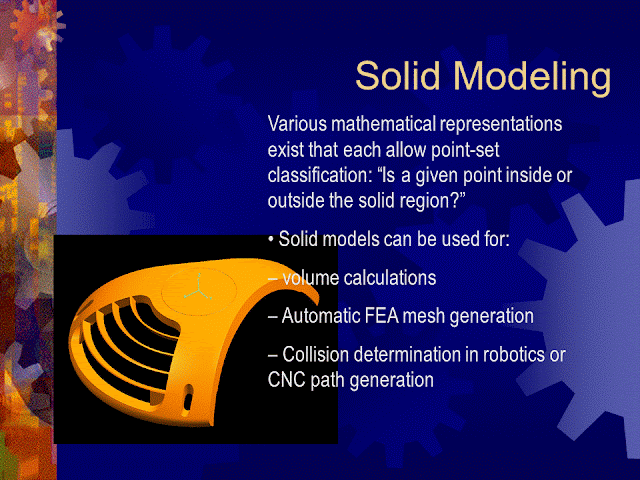
Wire frame, surface, and solid models


Friday, September 12, 2014

Technology through the Ages

Technology: the study of the designed world. Used to solve practical problems and extend human capabilities. Developments in technology are evolutionary, and are often the result of a series of refinements to an idea or basic invention.


Impacts of Technology: are divided into four categories: social (the impact on people), political (the impact on policy and laws), cultural (the impact on human achievement), and economic (the impact on the economy).


Paleolithic Age: the Old Stone Age, occurred between 500,000 BC and 10,000 BC and is marked by improvements to diet and security allowing the population to grow.


Mesolithic Age: the Middle Stone Age, occurred between 10,000 BC and 4,000 BC and is marked by the domestication of animals and agriculture.

Neolithic Age: the New Stone Age, occurred between 4,000 BC and 2,300 BC and is marked by specialization, division of labor, and the use of math and documentation of concepts.


Bronze Age: the architectural period that includes combining copper and tin to produce bronze; occurred between 2,300 BC and 700 BC.


Iron Age: the architectural period marked by the use of iron and steel; occurred between 700 BC and 450 AD.


Middle Ages: the architectural period after the Roman Empire; divided into Early Middle Ages, High Middle Ages, and Late Middle Ages; occurred between 450 AD and 1,400 AD and marked by the development of tools of war.


Renaissance: the architectural period marked by the revival of classical influence and the sharing of ideas; occurred between 1,400 AD and 1,750 AD.


Industrial Age: the architectural period marked by the first use of complex machinery, factories and urbanization, occurring between 1,750 AD and 1,950 AD.


Information Age: the architectural period marked by information sharing, gathering, manipulation, and retrieval; occurred between 1,950 AD and present.


Saturday, September 6, 2014

Balloon Powered Car

I really enjoyed this interesting challenge. When my group and I started this challenge we had no clue on how we were going to build a car. As the challenge went on and the time went by, we finally came up with an idea. We constructed the car in under 10 minutes, but we had a problem, we didnt know how to attach the balloon to the string. Just as we needed it Mrs. Mathieu came to the rescue and gave us a straw. When it was our turn we poked a hole in the balloon and sadly the balloon did not go a single centimeter up the string. Even though our project was a failure, I really had fun building it.

Wednesday, September 3, 2014

Reverse Engineering

Reverse engineering is a perfect to help you solve problems faster. By taking something thing apart you can see how the person built the product. That way by seeing how they built you can come up with a way to build it faster. That will make become a better problem solver. Eventually you will be able to solve problems in no time. This will help in the future by making you become a better engineer by brainstorming faster and creating faster. This is why reverse engineering helps you become a better problem solver and become a great engineer.

STAR Interview Question

Below is how I answered the STAR Interview question
Online recording software >>

Tuesday, August 19, 2014

Lab Safety Colors

What is ANSI? - The American National Standards Institute is the administrator of the US private sector standardization system for more than 90 years. ANSI accredits standards that are developed by different organizations, private or government.

Safety Colors - 

Red - Safety Red means Danger and/or Stop.

Common things that are red: fire protection equipment, containers of flammable liquids,stop bars and switches on machinery, fire alarm boxes, fire exit signs, blanket boxes, extinguishers, and sirens.


Yellow - Safety Yellow designates caution.

Common things that are yellow: caution, physical hazards, handrails, guardrails, exposed unguarded edges, exposed edges of platforms and curbing. doorway projections, and low beams. Yellow and black stripes or yellow and black checkers are used to mark traffic patterns.


Orange - Safety Orange identifies dangerous or parts of machines or energized equipment.

Common things that are orange: exposed parts of pulleys, gears, cutting devices, safety starting buttons, inside of movable guards, electrical switch bars, and fuse boxes.


Green -Safety Green designates safety and the location of first aid and safety equipment.

Common things that are green: first aid dispensers, first aid kits, eyewash station, 
safety showers, other safety equipment, and safety instruction signs.  


Blue - Safety Blue identifies safety information used on informational signs and bulletin boards.

Purple - Safety Purple represents Radiation Hazards